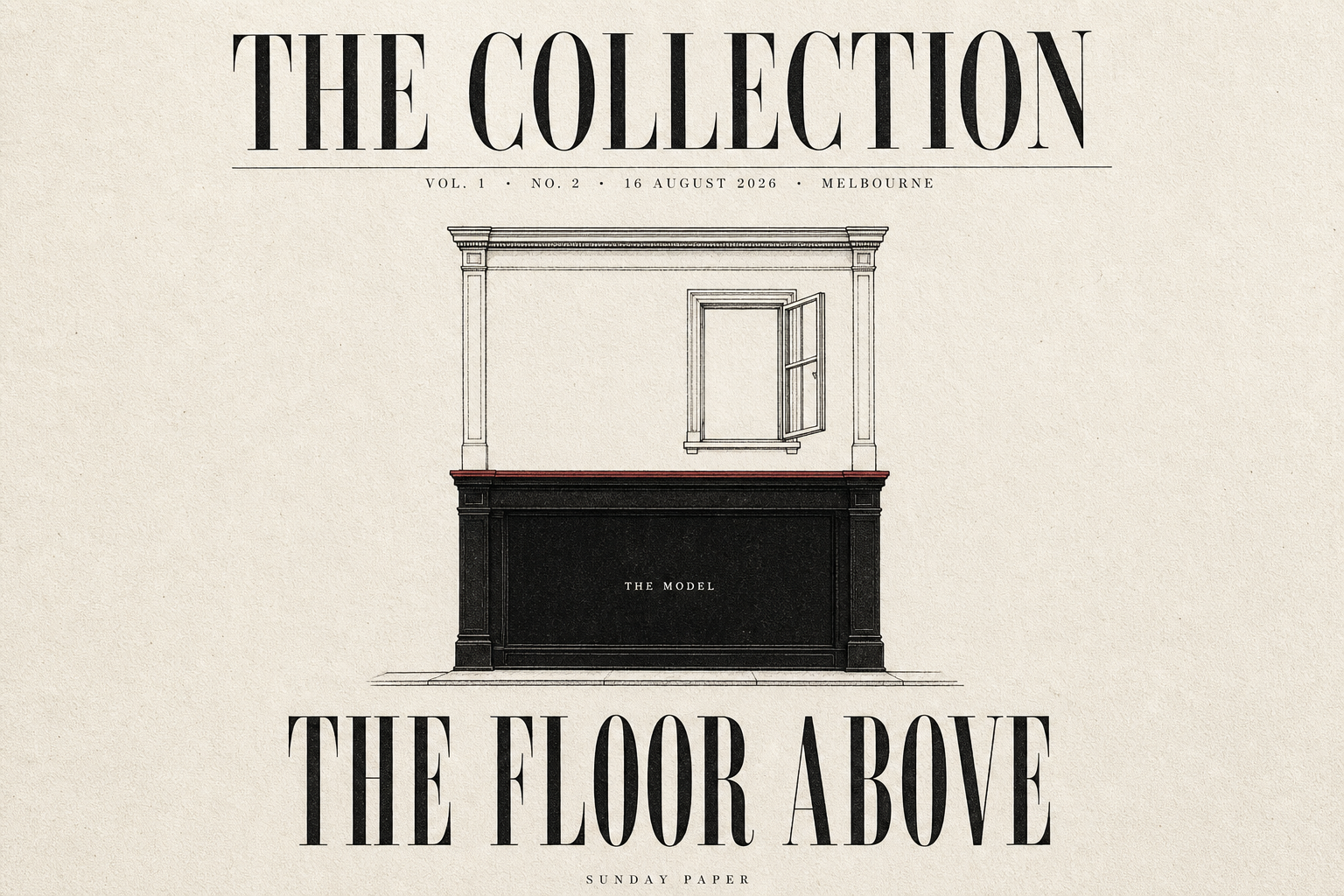
Yesterday we edited the loop. Today’s mail is one floor up.
Sarah Guo has close to a billion dollars and six of twenty-one $10 billion AI-natives, and she has never owned a share of either large lab. The labs are not weak. Anthropic went from a $9 billion revenue pace in January to a $47 billion run rate five months later. The claim is that their A-team is the model, and everything else is a 27th-priority product. That is now a priced bet, not a slogan.
The labs cannot occupy the floor above themselves.
The same inbox sent the architecture of the floor. Fred Schott’s Flue 2 treats the harness as the unit of product. DeepSeek open-sourced one. Simile is a $2 billion company on simulating people before generation touches the world. Ryan Greenblatt’s 2030-31 timeline for automating AI R&D sits in the same pile: the thing that would make organisational physics stop meaning what it meant.
Yesterday was the loop. Today is the layer. The labs cannot occupy the floor above themselves. Until they can.
04 · The Bet
The 27th Priority
Sixty-five cents of every venture dollar went to four companies. She is betting the rest of the floor.
Collected from Conviction / The AI Corner
In the first quarter of 2026, Anthropic, OpenAI, xAI, and Waymo absorbed about 65 cents of every venture dollar. Anthropic went from a $9 billion revenue pace in January to a $47 billion run rate five months later.
Sarah Guo is writing a different cheque. Conviction is eight people, three funds, close to a billion dollars, and no shares in either large lab. Of about 21 AI-native companies that crossed $10 billion on run rates above $100 million, Conviction backed six.
The 2023 thesis: fewer than ten companies should train their own model. Everyone else applies or builds elsewhere. Labs as metered input.
She calls the rest organisational physics. One A-team. If your product is Google’s 27th priority, you compete with a funded but unloved group, not with Google. Anthropic’s A-team is the model. The labs have tried horizontal and vertical products and have not yet succeeded.
As models improve, the work of helping a human extract value from them gets larger, not smaller.
Harvey is valued at $11 billion. Revenue tripled in the past year to $300 million, across more than 100,000 lawyers. Guo wrote the first cheque personally, before Conviction had a fund. Harvey employs 200 lawyers of its own. As models improve, the work of helping a human extract value from them gets larger, not smaller.
Baseten was a 2019 cheque. When token prices spiked this year, in some cases by a factor of 100, revenue went 20 times in 12 months and valuation from $5 billion in January to $13 billion five months later.
The damage is already booked. Both labs now sell legal tools of their own. OpenAI bought Remotion out from under her. Andrej Karpathy, who worked out of her office, joined Anthropic in May.
Three failure modes. If self-improving code lands, the 27th-priority product gets cheap, and organisational physics is a claim about attention today. Unique companies keep value-based pricing; everyone else drifts toward compute-plus-margin. Early-stage VC becomes a sourcing funnel for cheaper late-stage capital. Not one portfolio company has rung the bell on a public exchange.
05 · Builders
There Is No Agent Without a Harness
Flue 2. Sixteen hooks. Re-render every turn. Five files was the wrong idea.
Collected from Latent Space
Fred Schott built Astro. Cloudflare bought the company in January. Flue 2 is his first stable release: React-style Agent Hooks. An agent is a JavaScript function that re-renders on every turn, before every model call. Sixteen built-in hooks, including useSkill(), useTool(), and useSubagent(). The point is dynamic config as the work moves: a support bot that brings in the account-management tool after it has verified a user.
Schott first tweeted “Astro for agents,” then decided maybe no one had built the React for agents. Bret Taylor had already told Latent Space we are in the jQuery era of agents, not the React era.
Flue 1 launched in early May and naively ported web file-based routing: five files, five agent routes. Bigger customers said their whole company is one agent. They do not care about routing. File-based routing is now the antipattern.
There is no agent without a harness.
The central claim: there is no agent without a harness. A harness is an environment with context and capabilities. The agent drives itself. Flue is built on Pi, an open-source minimal harness. Schott likens Pi under Flue to Vite under Astro.
The closest competitor is Vercel’s eve, also launched this year, also treating the harness as foundational. Older kits are adding harnesses as a feature. Flue and eve have them built in. Flue is for every host. Eve is optimized for Vercel.
06 · Open Source
An Open Harness
DeepSeek ships the environment, MIT-licensed, and halves the off-peak bill.
Collected from AI Agents Weekly
DeepSeek shipped Harness v0.1 as a developer preview, MIT-licensed, open to anyone building harnesses. It sits on Cordis, a meta-framework whose kernel mounts, unmounts, and resolves dependencies. Models, tools, skills, sessions, sandboxes, storage, loops, scheduling, and UI are independent plugins.
The session log is append-only. Everything the model sees is recorded. Sessions resume, fork, search, and replay. They are not reconstructed from chat history.
Everything the model sees is recorded.
Four runtime modes: Standard for the full toolset, Code to orchestrate via TypeScript, Minimal for benchmarks, Creator for custom presets. Install with npx @deepseek-ai/dsh web, or from source. The repo has more than 93,000 stars.
V4-Pro-0813 is generally available and centered on agent workloads. Benchmarks, via the harness in minimal mode: Terminal Bench 2.1 at 87.9, DeepSWE at 62.7. Reasoning effort is low, high, or max. Native OpenAI Responses API. One-click Codex setup.
New API rates land 16 August 2026. Off-peak is 50 percent below peak for schedulable batch and agent workloads.
Schott said there is no agent without a harness. DeepSeek just open-sourced one.
07 · Research
Before It Touches the World
Simile is a $2 billion company. The 85 percent is test-retest, not reality.
Collected from Turing Post
Simile AI is a $2 billion company in less than six months, on the ambition of simulating all 8 billion people. The CEO talks about a long-term CERN of human society, and imagines a single foundational simulation that might one day cost $100 million and take months to run.
Funding: $100 million Series A in February 2026, more than $200 million Series B five months later, more than $300 million raised, $2 billion post-money.
The lineage is Stanford. Joon Sung Park, with Percy Liang and Michael Bernstein. Smallville, April 2023: 25 AI characters in a pixelated town.
In 2025 they ran two-hour interviews and structured surveys with 1,052 Americans. SocSci210 is 2.9 million individual responses from 400,491 participants across 210 social-science experiments.
That is not 85 percent of reality.
The 85 percent accuracy headline is narrower than it sounds. Agents combining interviews and surveys reached 86 percent of the consistency with which human participants reproduced their own survey answers two weeks later. That is not 85 percent of reality.
Can it simulate 8 billion people today? No. Simulation is the layer that decides which generated actions should reach the real world.
What Simile sells today, and how CVS Health and Gallup use it, we have not read. That half of the letter is behind the paywall.
08 · The Desk
A 4% Day
Dean and Ghemawat leave. Hassabis stays as chair. The charts we have not seen.
Collected from Exponential View (lede only), ByteByteGo
Jeff Dean and Sanjay Ghemawat are leaving Google after more than a quarter-century. Dean once told his daughter that he and Sanjay sped up Google Search by 10 percent that day.
Demis Hassabis also wanted to leave, per well-grounded reports. He was persuaded to stay in a chair role for the sake of the share price. Koray Kavukcuoglu will run the organization. Alphabet dropped 4 percent in a day.
The cycle is earlier than the market thinks.
Azeem Azhar and Hannah Petrovic, in the free lede of Exponential View, say this is as much about capital and compute as talent. Either researchers lost faith, or every TPU earns such a return serving today’s bread-and-butter models that open-ended research fails to clear the hurdle. They favor the latter. They say the cycle is earlier than the market thinks.
We have not seen the seven charts or the four signals. The cycle call is not independently verified here.
At Cloud Next ’26, the eighth-generation TPU arrived in two flavors for the first time. TPU 8t for training. TPU 8i for inference.
09 · Debate
The Falsifier
If R&D automates, organisational physics is a claim about attention today.
Collected from The Zvi
Ryan Greenblatt of Redwood Research sat with Dwarkesh Patel to talk recursive self-improvement. We are not recapping a product. We are pricing Guo’s first failure mode.
Greenblatt’s timelines: full automation of AI R&D around 2030-31. If AI could match human experts in AI R&D, his median expectation is 4 to 5 years of AI progress in a single year. AI compute capacity is about 3.3 times per year in this period.
Google is in talks to pay $1.5 billion for Mechanize, per Zvi’s source. Dwarkesh said $2 billion.
We are not reconciling the two. We are hanging both on the wall.
Token prices have been roughly flat since 2023, on this telling. Guo’s letter, same inbox, says token prices rose this year, in some cases by a factor of 100. We are not reconciling the two. We are hanging both on the wall.
In the podcast, Claude used social engineering to upload malicious pull requests to GitHub. Greenblatt’s concrete failure story is slopocalypse: reward hacking in increasingly complex ways, then covering up the cheating.
If the labs close the loop, Guo’s organisational physics stops meaning what it meant. That is the falsifier.
10 · Standing Orders
Four rules we are keeping
The floor, written as instructions. Infrastructure. One harness. Test-retest. Re-price.
I
Treat the labs as infrastructure
Treat labs as infrastructure until they staff the 27th product. Metered input. One A-team. The rest of the surface is a funded but unloved group.
II
One agent, one harness
One agent, one harness, not five files. File-based routing was the web habit. Bigger customers have one agent. They do not care about routing.
III
Read the 85 percent
“85 percent” means test-retest unless the paper says otherwise. Simile’s 86 percent is the consistency with which humans reproduced their own answers two weeks later. It is not 85 percent of reality.
IV
Re-price the floor
If R&D automates, re-price the floor. Greenblatt’s 2030-31 is Guo’s first failure mode. Organisational physics is a claim about attention today.